
A State Born Weak, Captured Strong: How Pakistan’s Democracy Was Doomed from the Start
By Aman Abdullah Shahid -
When Pakistan emerged as an independent nation in 1947, it was meant to embody the principles of self-determination, constitutionalism, and democracy. Yet from its earliest days, these ideals were compromised by the very structures and interests meant to uphold them. Within a decade of independence, power had shifted from the people to a small, unelected elite - a coalition of civil servants, landlords, and soldiers that would come to be known simply as the establishment.
This early consolidation of power was not an accident of history; it was the predictable outcome of a state born weak, captured strong.
The Fragile Foundations of a New State
Unlike India, which inherited the larger share of the colonial bureaucracy, industrial base, and political leadership, Pakistan began life as a fragmented and insecure dominion. It was divided into two wings separated by a thousand miles of hostile territory, burdened with refugee crises, and threatened by disputed borders.
In this climate of uncertainty, the country’s first generation of leaders faced immense challenges - but their greatest weakness was institutional. The new state lacked robust political parties, a clear constitutional framework, and experienced civilian administrators. Into this vacuum stepped the only organised and disciplined structures left behind by the British: the bureaucracy and the army.
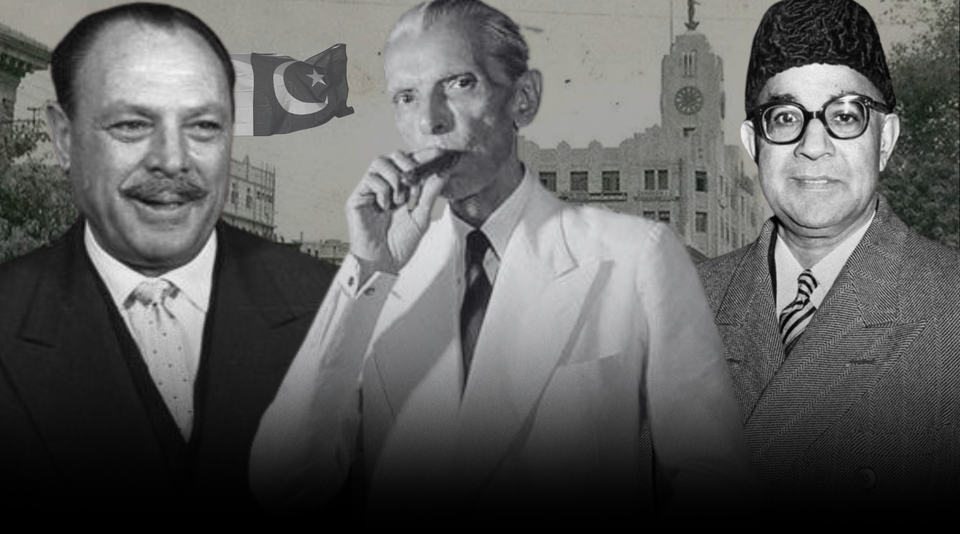
The death of Muhammad Ali Jinnah in 1948, barely a year after independence, deprived Pakistan of its founding authority. His successor, Prime Minister Liaquat Ali Khan, sought to establish parliamentary democracy and crafted the Objectives Resolution of 1949, a document that balanced Islamic values with democratic governance.
But Liaquat’s assassination in 1951 destroyed that fragile equilibrium. It not only robbed Pakistan of its most capable civilian leader but also emboldened unelected institutions. With no figure of comparable stature to rally behind, the bureaucracy and military filled the power vacuum, presenting themselves as the guardians of order and national survival.
From that moment, Pakistan’s democratic experiment was undermined by its own fragility. Civilian politicians were viewed not as representatives of the people but as liabilities to be managed.
The Colonial Bureaucracy and Its Paternalistic Legacy
The roots of bureaucratic dominance lay deep in the colonial past. Under British rule, the Indian Civil Service (ICS) had functioned as the empire’s administrative backbone - efficient, hierarchical, and profoundly undemocratic. After independence, many of its officers simply transferred to the new Pakistani state, carrying with them the same ethos of paternalism and control.
They regarded politicians as inexperienced, emotional, and corruptible. The bureaucrats, by contrast, saw themselves as dispassionate professionals - the natural custodians of the national interest. As early political parties floundered, these officials extended their reach from administration into policymaking and even political arbitration.
By the early 1950s, Pakistan’s civil servants were not merely executing policy - they were shaping it.
If the bureaucracy captured the state, the judiciary legitimised its capture. The critical moment came in 1954, when Governor-General Ghulam Muhammad dissolved the Constituent Assembly - the very body responsible for drafting Pakistan’s first constitution. When Speaker Maulvi Tamizuddin Khan challenged this act in court, the Federal Court, under Chief Justice Muhammad Munir, sided with the Governor-General.
This decision in Federation of Pakistan v. Maulvi Tamizuddin Khan established a devastating precedent: that political necessity could override constitutional authority. Munir’s so-called “doctrine of necessity” became the legal cornerstone for decades of undemocratic rule. Each time the constitution was suspended or a government dismissed, this doctrine was invoked to rationalise the violation of law.
Instead of acting as a check on power, the judiciary became one of its most dependable instruments.
The Rise of the Military and the Security State
While the bureaucracy dominated governance through paperwork and policy, the military claimed supremacy through the language of national security. The trauma of Partition, the 1947–48 war over Kashmir, and the continuing rivalry with India created an enduring sense of siege. In this climate, the armed forces were able to position themselves as the ultimate defenders of Pakistan’s existence.
Civilian governments, insecure and divided, relied heavily on the army for both defence and internal order. This dependency only deepened when Pakistan entered the Cold War alliances of SEATO and CENTO in 1954. These agreements brought in substantial American military aid, modern equipment, and training - resources that the army, not the civilian state, controlled.
As a result, the military’s institutional capacity and prestige grew far beyond that of any other organ of government. By the mid-1950s, it had become not just the guardian of Pakistan’s borders, but its most formidable political actor.
The 1956 Constitution: A Short-Lived Experiment
After nearly a decade of political wrangling, Pakistan finally adopted its first constitution in 1956, declaring itself an Islamic Republic with a parliamentary system. On paper, it promised representative governance and the rule of law. In practice, it arrived too late.
The country was already crippled by regional divisions between East and West Pakistan, factionalism among political elites, and the ever-growing interference of bureaucrats and soldiers. The constitution was stillborn - enacted but never allowed to function.
By October 1958, the experiment was over. President Iskander Mirza, himself a former civil servant, abrogated the constitution and declared martial law with the support of General Ayub Khan, the army’s commander-in-chief. Within weeks, Ayub ousted Mirza and assumed full control.
Pakistan’s first coup was complete - and the military had formally stepped into the political arena it had been quietly dominating for years.
The events of 1958 did not represent a rupture so much as a culmination. The first decade of Pakistan’s history had already normalised the concentration of power in unelected hands. Political parties were weak, fragmented, and often tied to feudal landlords rather than social movements. The bureaucracy had internalised its role as arbiter of politics. The judiciary had learned to justify executive overreach. And the military had come to view civilian rule as synonymous with instability.
This coalition of interests - bureaucratic, feudal, judicial, and military - became what Pakistanis would later call “the establishment.” It ensured that power circulated within the same narrow elite, while the principles of accountability and civilian supremacy remained theoretical.
From that point onward, democracy in Pakistan would survive only at the pleasure of those who did not believe in it.
A State Born Weak, Captured Strong
By the time General Ayub Khan imposed martial law, the contours of Pakistan’s political order were firmly set. The state had begun its life without institutional continuity, without charismatic leadership after Liaquat’s death, and without a culture of political compromise. In the absence of strong civilian institutions, the unelected arms of the state - bureaucracy, military, and judiciary - stepped in not as caretakers, but as claimants of power.
The tragedy of Pakistan’s founding years lies not in sudden betrayal but in gradual capture. What began as a temporary reliance on unelected institutions hardened into a structural dependency that endures to this day.
Pakistan’s democracy was not toppled overnight - it was smothered in slow motion.
The Legacy of the First Decade
The first eleven years of Pakistan’s existence created the template for everything that followed:
- Civilian governments without autonomy.
- A judiciary that bends to power.
- A military that governs from behind the curtain - or from the front when it chooses.
This was the original sin of Pakistan’s political system. Once democracy was subordinated to “stability,” the rule of law to “necessity,” and civilian leadership to “national security,” the foundation for authoritarian rule was laid.
Each subsequent era - from Ayub’s “guided democracy” to Zia’s Islamisation and Musharraf’s hybrid rule - would only elaborate on this design.
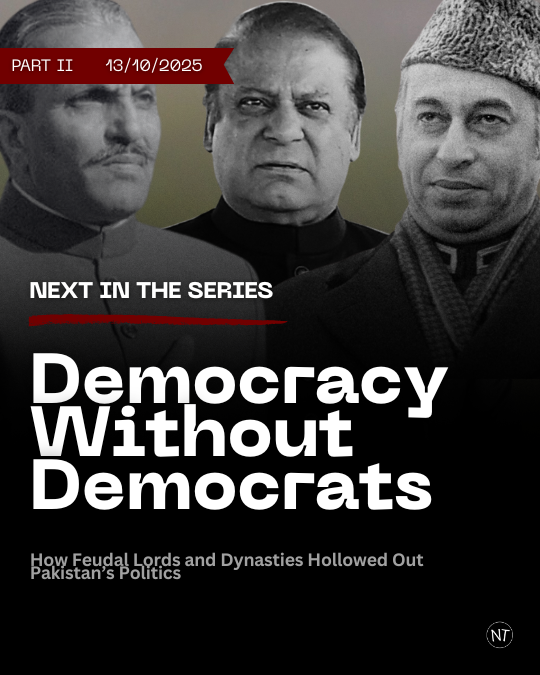
Next in the Series: “Democracy Without Democrats”
The next part of the series will be released next week. It explores how Pakistan’s political elites - feudal landlords and dynastic families - inherited this captured state, turning democracy into an instrument of control rather than a vehicle for change.



Member discussion