
FIFA: Football and the Manufacture of Political Legitimacy
By Burt Thorne -
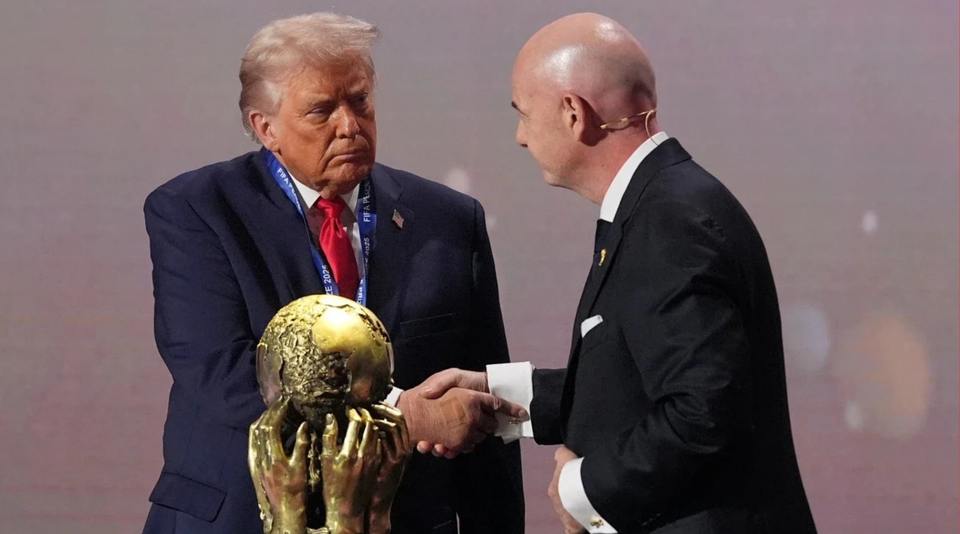
On 5 December 2025, Donald Trump was handed the inaugural FIFA Peace Prize during the draw for the 2026 World Cup. Amid the glitz of the Kennedy Center in Washington, a venue Trump himself chairs, the moment carried a distinctly political charge. FIFA president Gianni Infantino presented the gold trophy and medal while assuring the US president he could “always rely on [his] support.”
The display immediately raised alarms among observers, including the human-rights group FairSquare, which has now filed a complaint accusing FIFA of breaching its own neutrality rules by openly endorsing Trump’s administration.
The prize itself was Infantino’s creation, unveiled just 48 hours after Trump missed out on the Nobel Peace Prize he had vocally sought. As Infantino handed it over, he declared: “This is your prize, this is your peace prize.”
Its tagline “Football Unites the World” is undeniably true in many ways. But coming from FIFA, and bestowed on a president already using the 2026 World Cup as a stage for political prestige, it also hints at something far older: football’s long history as a tool for soft-power politics.
FIFA has a century-long pattern of enabling leaders to use the World Cup as a tool to project political legitimacy and soft power. From Mussolini in 1934 to Videla in 1978, Putin in 2018 and now Trump in 2026, FIFA has repeatedly worked hand in hand with strongmen who see football as a global stage to project their image and authority.
Mussolini’s Blueprint
Benito Mussolini was the first to see what a World Cup could do for a leader who needed legitimacy.
During the first decades of the 20th century, Italy's reputation as a second-rate power known for inefficiency, lack of organisation and weakness persisted. Mussolini, who had seized power through political violence and intimidation, was determined to change that perception. The World Cup offered the perfect stage.
Italy won the bid to host the 1934 tournament - the second World Cup ever held by making FIFA an offer it couldn't refuse: the Italian government would cover all losses. For a fledgling organisation still finding its footing, the promise was irresistible.
But for Mussolini, winning the tournament itself was secondary. What mattered most was proving Italy could organise it. The regime built impressive new stadiums that blended modernist architecture with Roman imperial grandeur. Foreign visitors found trains running on schedule and logistics to be smooth. The world watched, and the world was impressed.
Italy did win of course, helped, some alleged, by suspiciously favorable officiating. Mussolini's newspaper, Il Popolo d'Italia, ran the triumphant headline: "In the name and in the presence of Il Duce, the Azzurri win a new world title."
The World Cup had given the regime what it needed most: good press, international legitimacy, and a narrative of Italian exceptionalism that would fuel the fascist movement for years to come. Mussolini had achieved these ambitions with FIFA's complicity, a pattern that would persist. The formula was simple: quench FIFA's thirst for profits and guarantees, and they'll turn a blind eye to your politics.
FIFA's Structural Problem
But how did FIFA become an organisation that repeatedly enables controversial leaders? The answer lies in structural changes that began in the 1970s.
Under the presidency of João Havelange (1974-1998), FIFA aggressively pursued commercialisation and corporate sponsorship. Simultaneously, Havelange expanded FIFA's membership to strengthen his position against traditional European powers. The expansion might have been healthy had it advanced principles of justice, equality, and democracy. Instead, Havelange secured new members' allegiance through bribery and favors.
Since many of these new members came from undemocratically governed countries, their football associations operated in environments rife with corruption. FIFA's leadership exploited this, creating what scholar Vesa Vares describes as "a sort of vassal system by means of financial reward."
The consequences have been profound. Autocratic rulers discovered they could use the World Cup to showcase power, offer spectacle to the masses, and diminish the visibility of domestic problems, human rights violations, and political repression.
Argentina 1978: The Darkest Chapter
The most blatant example of an autocratic regime using the World Cup as political sports-washing came in Argentina in 1978. Two years earlier, a military coup had overthrown the elected government and installed a junta led by General Jorge Videla. The regime moved swiftly to eliminate dissent, deploying kidnapping, torture and extrajudicial killings to consolidate power. What became known as the “Dirty War” resulted in the death or disappearance of an estimated 30,000 people.
Despite multiple campaigns to boycott the tournament, including public calls from human-rights groups and pressure within several participating countries , FIFA president João Havelange insisted that football should remain “separate from politics”, a claim that conveniently shielded the regime from scrutiny. The World Cup went ahead as planned. In doing so, FIFA gave the junta a global platform on which to rewrite the emerging narrative, presenting a sanitised image of Argentina amid strict media repression. New infrastructure, a tightly controlled spectacle, and a controversial home victory helped achieve precisely that: the partial concealment of mass atrocities, with FIFA’s consent.
The enduring image of the 1978 World Cup is of Argentina’s captain, Daniel Passarella, lifting the trophy as Videla looks on, grinning, after personally presenting it to the victorious team. Less visible was the proximity of ESMA, one of the dictatorship’s largest clandestine detention and torture centres, located less than a mile from the Estadio Monumental. Survivors later recalled hearing the roar of celebration as prisoners were tortured inside its walls. For the duration of the tournament, FIFA offered the dictatorship what it needed most - the appearance of legitimacy.
Putin’s Power Play
In December 2010, FIFA awarded the 2018 and 2022 World Cups to Russia and Qatar respectively. The decision sparked immediate outrage. Both countries had questionable human rights records, and the bidding process reeked of corruption. The scandal would eventually bring down FIFA president Sepp Blatter in 2015 and lead to criminal indictments across two continents. Of the 24 FIFA Executive Committee members who made the decision, the majority were later convicted of corruption or accused in court of other misconduct.
The decision stood. Russia would host its first World Cup.
For Vladimir Putin, the tournament represented something more than sport. Since taking power at the turn of the millennium, Putin had made projecting Russian strength, both hard and soft power, a central goal. The World Cup offered the perfect stage. Russia's international reputation had suffered following the 2014 annexation of Crimea, accusations of election interference abroad, and high-profile assassinations on foreign soil. Putin needed what Mussolini and Videla had needed before him: a chance to rewrite the narrative.
The World Cup proved an unquestionable public-relations triumph. Visitors were struck by gleaming new stadiums, free transport between venues, and an atmosphere notably free of crowd violence. Russia presented itself as open, efficient, and welcoming a sharp contrast to its reputation for authoritarianism. For one month, the country commanded global attention for positive reasons, exploiting the tournament to soften its image and briefly eclipse the diplomatic damage accumulated since 2014.
FIFA played a crucial role in this transformation. By insisting that football remain above politics, the organisation once again offered an embattled leader a global stage on which scrutiny was suspended and legitimacy quietly restored. FIFA president Gianni Infantino hailed the tournament as “the best World Cup ever” and claimed it had “changed the perception the world has about Russia”. Shortly afterwards, he was awarded Russia’s Order of Friendship by Putin himself at a ceremony in the Kremlin.
The soft-power gains endured until February 2022, when Russia launched its full-scale invasion of Ukraine. FIFA banned Russian teams from international competition, but by then, the damage was done. Putin had enjoyed four years of image rehabilitation. The World Cup had served its purpose.
World Cup 2026
Which brings us back to Donald Trump and December 5, 2025. In previous cases, FIFA’s defence has been consistency: a rigid commitment to political neutrality that, in practice, enabled strongmen to use the World Cup as a vehicle for prestige and authority. With Trump, even that pretence has begun to erode. Following his inauguration in January 2025, Infantino pledged to work alongside the new president to make “not only America great again… but the entire world.” Under Infantino, FIFA has increasingly sought proximity to political power, pursuing transactional relationships with leaders able to guarantee access, security and profit.
The incentives surrounding the 2026 World Cup are immense. The tournament is set to be FIFA’s most lucrative ever, expanded to 48 teams, with record-breaking broadcast deals, soaring ticket prices, often reaching five figures, and long desired access to the US market. For FIFA, the rewards are financial. For Trump, the tournament offers something equally valuable: a global stage on which to project authority, command attention and distract from a deeply polarised domestic climate and mounting foreign-policy controversies.
The alignment is mutually beneficial, and deeply familiar.
The Human Rights Concerns
In June 2025, Trump issued an executive order restricting entry from multiple countries, including Haiti and Iran - both of which have qualified for the 2026 World Cup. The move complicates travel for players, officials and thousands of supporters, raising questions about whether FIFA will intervene or once again defer to a host nation’s policies.
Human rights organisations have issued more serious warnings. FairSquare, which filed the complaint against FIFA over the Peace Prize ceremony, has cautioned that US Immigration and Customs Enforcement (ICE) may use the tournament as an opportunity for heightened surveillance and arrests. ICE has declined to rule out enforcement operations at or near stadiums.
For immigrant communities, particularly Latino populations in host cities, the World Cup may represent not celebration but risk. Advocates warn that fear of detention or deportation could deter families from attending matches or even travelling near venues. A tournament marketed under the slogan “Football Unites the World” may instead push vulnerable communities further into the shadows.
Ticket sales, meanwhile, continue to surge.
This is football’s enduring contradiction. Its global appeal, emotional pull and commercial power continue to function irrespective of the abuses that surround it. FIFA knows this and has long relied on it. From Mussolini to Videla, from Putin to Trump, the organisation has repeatedly demonstrated that when spectacle, profit and political power align, principle is negotiable.
Member discussion