
Pakistan’s Deadly Floods: The Not so Natural Disasters:
By Dr Haider Ali Khan
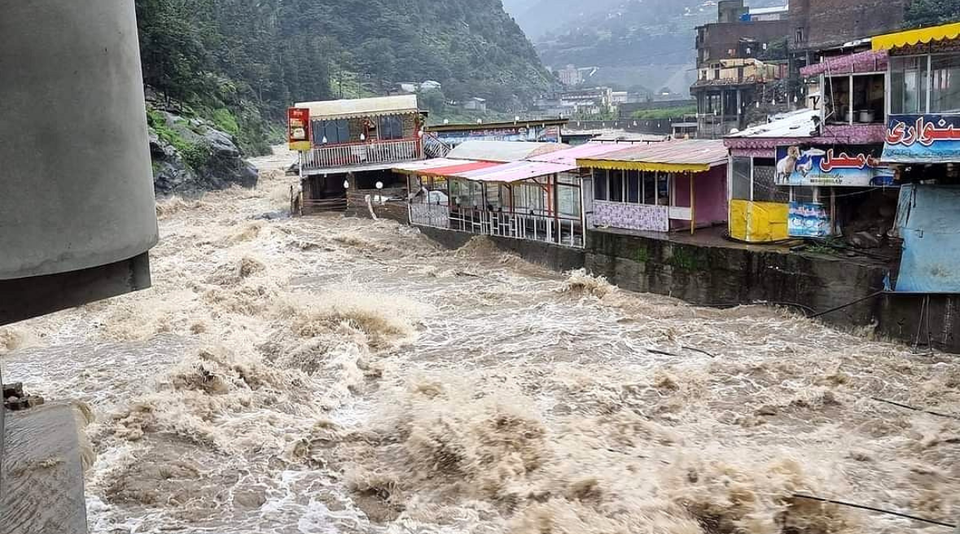
The North of Pakistan has once again been devastated by flash floods and cloud bursts. Dozens of people have lost their lives, while thousands more have seen their homes, crops, and livelihoods destroyed. Entire villages have disappeared, buried under rubble along with their residents. I think back to the floods of 2010; at the time a natural disaster on such a massive scale was completely unprecedented. The subsequent loss of lives and destruction was unparalleled with any floods we had experienced in our lifetimes. Now, we have come to expect floods on a similar scale every few years. The uncomfortable truth is that these disasters are not entirely natural. Man-made climate change is the driving force. Unless we acknowledge this and change course, the destruction will only grow.
As a former member of Parliament and the Climate Change Committee of the National Assembly of Pakistan, I have seen first-hand how climate change has emerged as a serious existential threat to the entire planet. Among the countries most vulnerable to its immediate and severe effects, Pakistan stands alarmingly high on the list.
Our contribution to global greenhouse gas emissions is minimal compared to industrialised nations, yet the burden we bear is disproportionately large. This is a grave injustice: Pakistan emits less than 1% of global emissions, yet we are ranked among the top ten countries most affected by climate disasters. This global inequity, when coupled with our own domestic governance failures, makes the crisis even more severe.
The science is clear. Even a 1.5°C rise in global temperature has triggered accelerated glacial melt. In Chitral, glaciers have lost 31% of their ice area over the past three decades. In the iconic Passu glacier, that shrinkage is ongoing - it’s now almost 10% smaller and continues to retreat several meters each month. Across the Pamir Plateau, glaciers began a sharp decline after 2015, losing up to 1,000 km² per year.
Global warming provides the backdrop, but Pakistan’s domestic failings magnify the destruction. Rampant deforestation has stripped our northern hillsides bare, removing the natural defences that once absorbed rainfall, prevented landslides, and acted as carbon sinks. Meanwhile, the unregulated stone-crushing industry destroys fragile mountain landscapes, destabilising slopes and accelerating erosion.
Unplanned urbanisation adds another layer of risk. Housing schemes and roads frequently block natural waterways, while illegal construction within river beds and tributaries narrows flood channels. When heavy rains come, water has nowhere to go but through towns and villages.
Our reliance on low-quality fuels is another pressing problem. These fuels not only emit excessive greenhouse gases, worsening climate change, but also release toxic chemicals that drive alarming rates of respiratory disease across Pakistan. While much of the developed world now operates on Euro 6 fuel standards, we remain stuck at Euro 2. The consequences are dire: Lahore and five other Pakistani cities consistently rank among the world’s fifteen most polluted, leaving millions exposed daily to air that shortens lifespans, damages children’s development, and overwhelms healthcare systems.
At the heart of these problems lies weak governance. Environmental regulations are either ignored or non-existent, while powerful lobbies profit from destruction. Too often, leaders prioritise short-term financial and political gains over long-term sustainability. The result is a country repeatedly caught unprepared for disasters that are increasingly predictable.
It is vital to understand that climate change is not just an environmental issue - it is a human crisis. Floods wash away not only homes but also crops, livestock, schools, and health facilities. Families are pushed deeper into poverty, women and children are disproportionately affected, and displacement leaves lasting scars on communities.
The economic cost is staggering. The 2022 floods alone caused losses exceeding $30 billion - nearly 10% of Pakistan’s GDP. Without decisive action, such destruction will become routine.
While global climate negotiations remain crucial, Pakistan cannot wait for others to act. There are immediate steps within our own control.
We must prioritise afforestation and ecosystem restoration. Planting drives should focus not just on numbers but on survival rates, with communities incentivised to protect forests. Protecting what remains is just as important as planting new trees.
Urban planning requires urgent reform. Construction in floodplains must be banned, blocked tributaries restored, and zoning laws enforced to prevent reckless development. Pakistan also needs to accelerate its clean energy transition - phasing out low-quality fuels, enforcing emission standards, and investing in solar, wind, and micro-hydel power. This would reduce local pollution while also cutting reliance on costly fossil fuel imports.
Preparedness is equally vital. The NDMA and provincial authorities need modern forecasting systems, early-warning networks, and well-equipped rapid response units. At the community level, awareness campaigns and evacuation drills can save countless lives. Finally, climate education must be embedded nationally, creating a culture of sustainability and resilience.
The recent calamity is yet another wake-up call. While the global responsibility for climate change rests largely with industrialised nations, Pakistan cannot use this as an excuse for inaction. Our governance failures - deforestation, weak regulation, unplanned urbanisation - leave us dangerously exposed.
Unless we act decisively, the cost in human lives and economic damage will continue to rise. Climate resilience must not be treated as a secondary priority but as a matter of national survival. The time for rhetoric has passed. Pakistan needs immediate, actionable reforms to protect its people, economy, and environment before it is too late.



Member discussion