
Radical Right Populism: Parallels Between the Bush Administration's Conduct in the Iraq War and Trump's Style of Authoritarian Populism
By Abigail Forster -
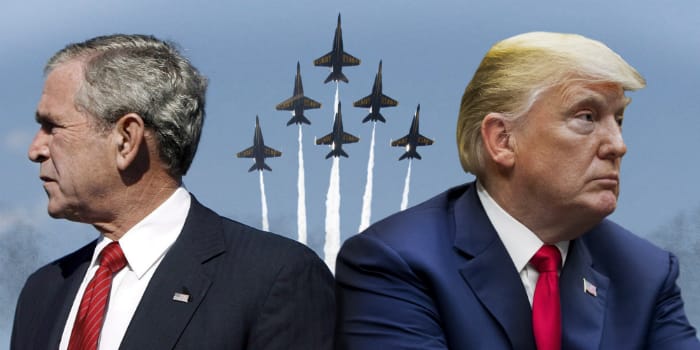
The actions of the Bush administration during America’s invasion of Iraq in 2003 and subsequent ‘Global War on Terror’ (GWOT) – and all its consequences – resulted in a population susceptible to the persuasions of radical right populism. By the end of his presidency, Bush’s approval ratings had nosedived and trust in the government had depleted. The government had increasingly begun to be viewed as an ‘unresponsive elite’ that no longer represented the views of the population. And thus the seeds were sewn for the rise of radical right populism.
To understand what radical right populism is and why it has the potential to pose a significant threat to communities at a local level and international relations (and even to some extent democracy itself), first one must understand what populism is, and how it has transformed into the political tool used by so many today.
Whilst populism first appeared in America in the form of a political party in America called ‘The People's Party’ in the 1890s, a party for agricultural and industrial workers and their unions, it has now transformed into a political tool or approach, rather than an individual political party. In the current political sphere, political figures that employ such a rhetoric often promote an ‘us-versus-them’ mentality, preying on factions within communities and manipulating fears and insecurities to gain public support.
But is modern populism inherently bad?
The short answer is no. Like any political tool or approach, populism itself is not negative or positive. The overall nature of populism is dependent on the politician or party employing it. So, whilst some use it to capitalise off of divisions in society, it can also be (and has also been) used to empower communities against oppressive ‘elites’.
In the words of philosopher Ernesto Laclau;
Hence, populism cannot be ‘good’ or ‘bad’ – but it can be used for both ‘righteous’ or well-meaning aims and self-serving, disingenuous ones, by all sides of the political spectrum. The answer to this question is ultimately dependent on who it is employed by and for what purpose.
Radical right populism and authoritarian populism
This is where we see populism being used manipulatively. Radical right populism frequently preys on the public fears and insecurities of (albeit sometimes perceived) socially disadvantaged groups that feel as if they are being increasingly disregarded by the government. Sometimes these fears or concerns are even manufactured by the ‘populist’ to increase their own appeal. At times this teeters into authoritarian populism, something many have accused President Trump of encompassing. Authoritarian populism refers to a leadership style that exacerbates moral panic or indignation to consolidate power and authority, with its leaders presenting themselves as the singular voice of reason and the only figure people can trust to restore true representative democracy. They are the ‘morally pure’ against the immoral, unresponsive ‘elite’.
So, how did the Bush administration fuel the rise of radical right populism?
Omer Aaziz has written a very compelling article discussing why the Iraq War was such a major foreign policy disaster. He also argues that the failings of Bush’s actions in the Middle East inadvertently resulted in the presidency of Donald Trump in 2016.
The invasion of Iraq and subsequent invasions of the Middle East were based on a lie. Whether Bush knew he was acting on faulty information and knowingly misinformed the people, or if individuals within his administration fed him faulty information to ensure a particular outcome, it cannot be denied that the reasons Bush and his administration gave to justify invading Iraq were categorically not true. Saddam Hussein had no links to al-Qaeda and 9/11. He was not building a nuclear arsenal. After the invasion, U.S. forces found no evidence that Saddam Hussein possessed any nuclear weapons, and the subsequent Select Committee Report investigation into the war found no links between Saddam Hussein and the 9/11 attack. And here the idea of what would come to be known as the ‘big lie’ had been exposed – the idea that presidents and their administrations could ‘lie’ or ‘misinform’ the public for the sake of the ‘greater good’ (or just to achieve their domestic/foreign policy initiatives). The actions of the Bush administration set a dangerous precedent that presidents could manipulate intelligence to influence public opinion all in the name of homeland security.
The Iraq war also destroyed public trust in the government. After discovering that their president lied to them and sent them to war based off of faulty information, this is not surprising. With public trust at an all-time low, it was only a matter of time before a figure like Trump came in spouting populist rhetoric.
The ‘Big Lie’
The ’big lie’ precedence set by the Bush administration in the aftermath of Iraq and GWOT laid the foundations for Trump’s political leadership style. In both his terms, Trump repeatedly established particular groups to be the subject of populist discourse, often by spreading misinformation and outright lies to suit his political agenda.
Somewhat ironically, in his 2016 election campaign Trump used the failings of the Bush administration to unite supporters across varying social groups, labelling Bush and the subsequent administrations an unresponsive elite unworthy of the public’s trust – Bush to some extent became the subject of Trump’s radical right populist campaign.
Trump established himself as the exact opposite of Bush – anti-war, anti-foreign intervention, a man of the people worthy of the public’s trust. He would ‘Make America Great Again’ and restore trust in the government.
In his current presidency we have seen the exact opposite. He is not anti-war. He is not anti-involvement in foreign affairs. Despite labelling himself a man worthy of a Nobel Peace Prize and the only man able to secure peace between Russia and Ukraine and across the Middle East, his actions suggest otherwise.
Ultimately, whether you are pro-Trump or anti-Trump, or even indifferent, there is no denying that he is a populist leader. As previously stated, populism is neither inherently good nor bad, however it would be naïve to ignore the dangers of Trump’s style of authoritarian populism.




Member discussion