
Your Party: Game Changer or Gimmick?
By Wali Khan
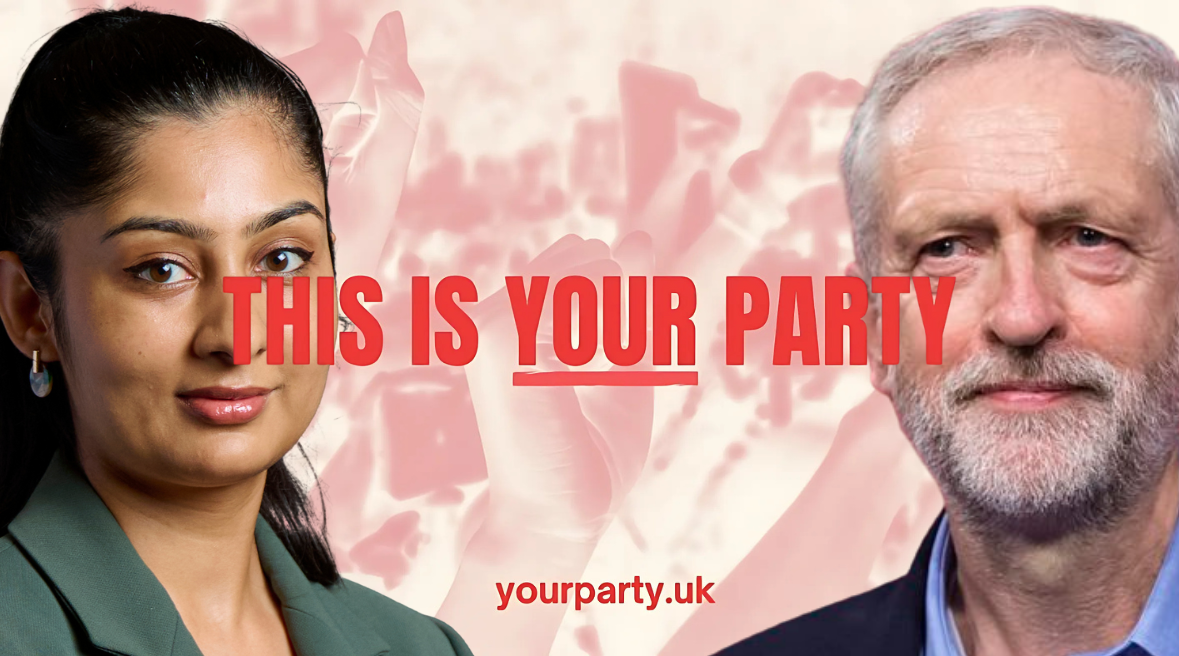
Jeremy Corbyn and Zarah Sultana announced their new political movement – Your Party – in July this year. In just a few weeks, they have attracted over 700,000 “members,” a figure that has quickly caught public attention. Yet much about the party remains unknown, including its actual name. Your Party is only a placeholder; the final name will be decided by its members. The same democratic process will also determine the leadership structure and other key aspects of the organisation.
Although many details are still to be confirmed, the party’s core goals are already clear. Corbyn and Sultana want to build a democratic, inclusive decision-making model to pursue:
- Wealth redistribution and the nationalisation of key services
- Expansion of social housing and protection of the NHS from privatisation
- An end to arms sales to Israel and a peace-oriented foreign policy
- Ambitious climate action and the defence of the right to protest
- Strong roots in grassroots social movements, communities, and trade unions
These goals are, on paper, highly popular with the British public – something reflected in the rapid 700,000 sign-ups. Corbyn has noted this number already exceeds Labour’s peak membership of 600,000 and is currently the highest of any party. However, it is important to stress that these “members” are essentially on a mailing list, not paying members. By contrast, all established parties charge fees – £58 a year for Labour and £25 for Reform UK. Comparing free sign-ups to paid memberships is therefore not an accurate measure of relative popularity. The party’s official membership rules and fees will be announced in the autumn, at which point their numbers will be directly comparable to others.
Even so, it would be wrong to suggest the party will struggle to attract genuine support. Appetite for a radical left-wing party is growing, and this is exactly the political space they hope to fill. At the same time, Labour is drifting further from its left-wing base, with many feeling it no longer represents them. For these voters, Keir Starmer is a centrist, not “one of us,” and recent decisions have reinforced that perception. His suspension of MPs – including Sultana – for voting against the two-child benefit cap, his Farage-style rhetoric on immigration, and his stance on Israel-Palestine have deepened the disconnect.
The numbers reflect this disillusionment: Labour’s membership has fallen 11% since the election and now stands at 309,000. Corbyn, by contrast, remains popular with the same voter base. Despite losing the 2019 general election, his Labour still won 10.27 million votes – around 500,000 more than Starmer achieved in 2024. In 2017, Corbyn received 12.8 million votes, the highest number for Labour in the 21st century.
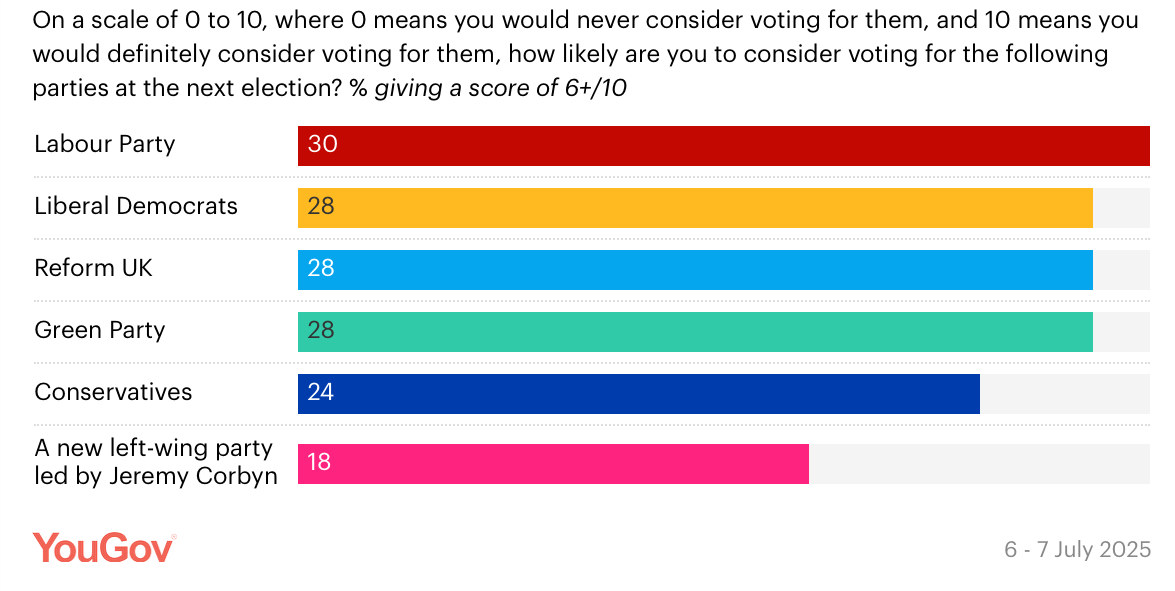
Polling suggests there is space for a new party. Already, 18% of Britons say they would consider voting for a Corbyn-led party – including 58% of 2024 Green voters and 31% of 2024 Labour voters. Although this is promising, it is less than the established major parties as expected.
Critics argue such a party would struggle to build momentum and would simply split the left-wing vote, handing Nigel Farage victory in the next general election. But it is worth noting that Starmer may be doing that himself: early polling shows Reform leading Labour by 3–4 points. With Reform’s support growing and Labour’s shrinking, a left-wing split may not make much difference. In fact, the fear of splitting the vote can itself stunt political growth, gradually pulling the political centre of gravity further to the right. For many left-wing voters who will not back Starmer under any circumstances, the least they deserve is a viable alternative that champions their priorities and delivers on its promises.
The same warnings were once given to Nigel Farage. He was urged to re-join the Conservatives rather than form Reform UK, for fear of splitting the right-wing vote. A year later, Reform has overtaken the Conservatives in popularity and now threatens Labour directly. If a populist right party can thrive, perhaps it is time to seriously consider a populist left alternative to counter it.
The new party hopes to be ready for the 2026 local elections, which they see as a springboard for growth. But doubts remain. Even before it is formally established, Your Party has been branded chaotic and unserious. Reports of tension between Corbyn and Sultana have added to this image. Sultana announced in early July that she was leaving Labour to form a new party with Corbyn – who only cautiously confirmed that discussions were taking place. According to reports, he had not expected her announcement and was frustrated by it. On 24 July, both shared a link to the party’s website and made the venture official.
Since then, differences have persisted. Corbyn insists the leadership will be decided by the members, whoever they choose. Sultana also supports a member-led process, but continues to suggest she would prefer to co-lead alongside Corbyn. The contrast is important. So far, the party’s message has projected inclusivity, egalitarianism, and democracy – principles Corbyn recognises must extend to leadership if the party is to establish a strong, credible identity. Sultana’s public preference for a specific outcome muddies that image. To reinforce the idea of a “party for the people,” leaders must show they put the party’s best interests before their own.
This may reflect a lack of confidence in her position and a desire to cement herself as Corbyn’s equal in the party’s creation, rather than a supporting act. Both are undoubtedly capable and politically astute, and it seems likely the leadership will end up as Sultana envisions – with the two of them at the helm. Corbyn may expect this too, but he appears to understand that openly predicting such an outcome would undercut the party’s democratic image.
If they can translate their digital surge into a disciplined, united movement by 2026, Your Party could rewrite the script for Britain’s left. If they cannot, they risk joining the long list of protest parties that burned brightly but faded fast.

Member discussion